
If you are searching for an AML KYC course in Hyderabad, you will see dozens of institutes saying “complete syllabus” and “job-ready training”. But what should a good AML KYC syllabus actually include, who can join, and how do you tell a practical course from a theory-only one? This guide answers those three questions, using real 2026 rules and a real Hyderabad job post.
Why the Syllabus Matters in 2026
KYC rules in India are not static, and employers expect new analysts to know the current ones.
- The RBI’s Know Your Customer Directions, 2025 for commercial banks were issued on 28 November 2025 under the Prevention of Money Laundering Act, 2002, and the RBI lists them as updated as on 1 October 2026.
- On 18 September 2026, the RBI issued the KYC Amendment Directions, 2026, changing the “certified copy” rule so that banks can also accept overseas-certified documents for Foreign Portfolio Investors, not only for NRIs and PIOs.
- On 24 November 2026, India Today reported that the RBI has released draft rules on digital payment fraud, including a “Stop Switch” to block all outward debits and an optional “trusted person” approval for high-value transfers. These are proposals, not final rules.
A syllabus built years ago and never updated will not prepare you for questions about these changes. When you compare courses, ask: “When was this syllabus last updated?”
What a Good AML KYC Syllabus Should Cover
Here is the module structure we teach at UniQode Tech, and what to look for in any course.
1. Foundations and the regulatory landscape
What AML and KYC are, why banks need them, and the rules behind them: FATF recommendations, FinCEN, OFAC sanctions programmes and EU AML Directives globally, and in India the RBI guidelines, PMLA, SEBI regulations and FIU-IND reporting. You should also learn key terms such as PEP, beneficial ownership, STR/SAR/CTR and the three stages of money laundering.
2. KYC lifecycle and due diligence
This is the heart of most entry-level jobs: the Customer Identification Program (verifying identity documents), individual versus corporate onboarding, Customer Due Diligence (CDD), Enhanced Due Diligence (EDD) and the risk-based approach (risk scoring and risk matrices). Look for onboarding simulations, not just slides.
3. Screening, plus an introduction to transaction monitoring
Sanctions screening against OFAC, UN, EU and HMT lists, name screening versus transaction screening, spotting red flags, and the basic alert flow (alert, L1 review, L2 escalation, STR/SAR). At UniQode Tech, transaction monitoring is covered at a basic, introductory level, so you understand how alerts work before you specialise later.
4. Ongoing monitoring and quality control
Periodic review (KYC refresh), adverse media screening, QA/QC frameworks, KYC remediation projects, and data privacy basics including India’s DPDP Act. A full end-to-end KYC case review should be part of this.
5. Compliance reporting and governance
Reporting and audit trails, internal controls, the three-lines-of-defence model, escalation, and newer risks such as crypto and trade-based laundering.
6. Tools, soft skills and interview readiness
Exposure to screening and case-management systems, writing clear case notes and emails, mock alert investigations, mock interviews and resume work for KYC Analyst, AML Analyst and QC roles.
How to test any syllabus: compare it with real job posts. For example, a KYC Analyst post by Delta Capita in Hyderabad (published 20 November 2026) asks the analyst to screen clients for sanctions, PEPs and adverse media, remediate and refresh KYC records after periodic reviews, and compile “audit-ready” KYC files. Modules 2–4 above map directly to that work.
Who Is Eligible for an AML KYC Course?
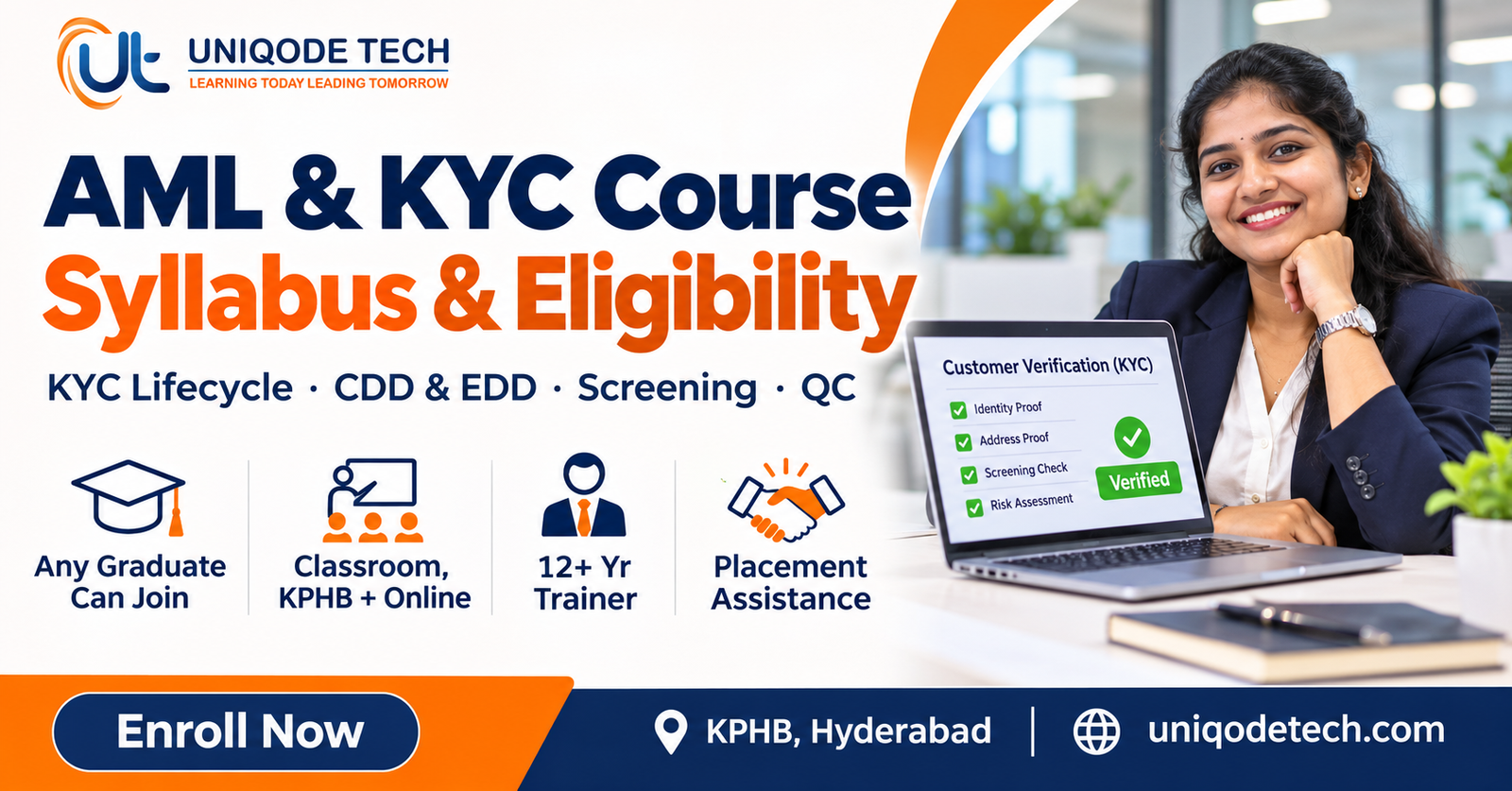
You do not need a finance degree or banking experience to start learning. Our AML & KYC course in KPHB, Hyderabad suits:
- Freshers and graduates from any degree. B.Com, BBA, MBA (Finance) and economics graduates find the concepts familiar.
- Career switchers from back-office, finance operations, BPO/KPO or customer service.
- Operations staff already handling banking or finance processes who want to move into compliance.
- Career-gap returners looking for a stable, skill-based role.
- Existing KYC/AML associates who want stronger EDD, QC and reporting skills.
One honest point: many analyst roles list a degree and some experience. The Delta Capita post above says “Bachelor’s degree required” and asks for 2–4 years of KYC, CDD or financial-crime experience. Freshers usually start in associate or operations-level KYC roles and grow from there, which is why practical, case-based training matters. Our guide to AML KYC jobs for freshers in Hyderabad explains those first roles.
Five Questions to Ask Before You Join
- Is the syllabus updated for 2025–26 RBI KYC rules?
- Who teaches it? Ask for the trainer’s real industry experience.
- How much hands-on work is there? Simulations, case reviews and mock STRs matter more than slides.
- Are classes recorded? You will want to revise before interviews.
- What does “placement” mean? Prefer honest placement assistance (resume help, mock interviews, referrals). Be careful with any “100% guaranteed job” promise.
Learn AML & KYC at UniQode Tech, KPHB
- Trainer: Kiran Kumar, 12+ years of experience, working with a leading fintech company
- Classroom at KPHB (about 5 minutes from the metro station) or live online
- Class recordings on UniQode Tech’s dedicated LMS
- Onboarding simulations, alert-review exercises, a full KYC case review and a mock regulatory audit
- Placement assistance: resume building, mock interviews and job referrals
New to the topic? Start with our overview of AML & KYC training in Hyderabad. Ready to start? See the full module list, current fee and next batch on the AML & KYC course page and Enroll Now.
Frequently Asked Questions
1. What is the syllabus of an AML KYC course?
A practical AML KYC syllabus covers AML/KYC foundations and regulations (FATF, RBI, PMLA, FIU-IND), the KYC lifecycle with CDD and EDD, sanctions and adverse media screening, an introduction to transaction monitoring, quality control and periodic review, compliance reporting, and interview preparation.
2. Who is eligible for an AML KYC course in Hyderabad?
Graduates from any stream can join. B.Com, BBA, MBA (Finance) and economics graduates find it familiar, and career switchers from BPO, operations or customer service also do well. No banking experience is needed to start learning.
3. Does the UniQode Tech course cover transaction monitoring in depth?
No. Transaction monitoring is covered at a basic, introductory level (alert flow, L1/L2 review and a mock STR). The course focuses on the KYC lifecycle, due diligence, screening and quality control.
4. Does UniQode Tech guarantee an AML or KYC job?
No. We provide placement assistance: resume building, mock interviews and job referrals. Job offers depend on your interview performance and the hiring market.